When I finally put my last post online, I realized that I also love to theorize. Going back to my post on Generation Y, here is a picture to summarizes that text.
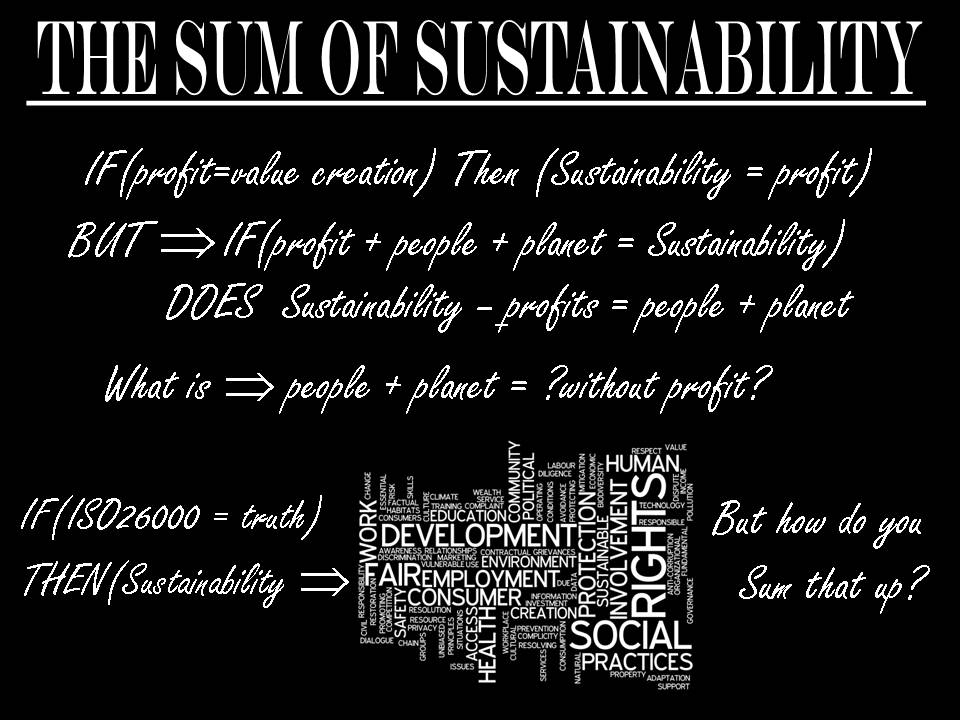

When I finally put my last post online, I realized that I also love to theorize. Going back to my post on Generation Y, here is a picture to summarizes that text.
The New York Times recently released an online article intitled: « To Be Good Citizens, Report Says, Companies Should Just Focus on Bottom Line ». I suggest you read it since it has many interesting facts.
I’m always in the middle of discussions between professionnals who talk about the importance of KPIs and the tripple bottom line. On the other hand, and to some in this article, the social responsibility of business is to make profits as stated by Friedman. Well to surprise a few, I would have to agree with Friedman…
Obviously, I couldn’t go and argument on the article he made in the 70’s since I’m myself propably going to have matured in the next couple of years and be able to improve what I’m writting these days. So I can’t argument on a statement made 40some years ago.
I would like to start on the premise that the societal responsibility of business is to make profit. But what is profit? Seems like a pretty stupid question, I agree. But bear with me a bit. Why was money invented? Here is what Wikipedia tells us about money:
Money is any object or record, that is generally accepted as payment for goods and services and repayment of debts in a given country or socio-economic context.[1][2][3] The main functions of money are distinguished as: a medium of exchange; a unit of account; a store of value; and, occasionally in the past, a standard of deferred payment.[4][5] Any kind of object or secure verifiable record that fulfills these functions can serve as money.
But the question was: what is Profit?
In economics, the term profit has two related but distinct meanings. Normal profit represents the total opportunity costs (both explicit and implicit) of a venture to an entrepreneur or investor, whilst economic profit (also abnormal, pure, supernormal or excess profit, as the case may be monopoly or oligopoly profit, or simply profit) is, at least in the neoclassical microeconomic theory which dominates modern economics, the difference between a firm‘s total revenue and all costs, including normal profit.[1] In both instances economic profit is the return to an entrepreneur or a group of entrepreneurs. Economic profit is thus contrasted with economic interest which is the return to an owner of capital stock or money or bonds.
And thus I believe that the societal responsibility of business is to make profits, although the monetary aspect of it is suppose to be a translation of value creation between entities. I would not state that Creating Shared Value (CSV) surpases Sustainability as Michael E. Porter and Mark R. Kramer present it in their Harvard Business review article. I would say that CSV is sustainability. One model among others. Although Porter and Kramer present it with their usual brilliance.
But lets keep this short enough. Money is the translation of value from one entity to the next. Profit is the gain that can be made when exchanging values between entities. This gain is depends on the perception of value by the entities. Thus if we consider money as a medium of value, a single bottom line is enough if we are able to translate externalities as well as direct gains in monetary terms. Utopian you say? Well Rio Tinto in its Social Risk Analysis tool gives a monetary value to its social acceptability. Althoug imperfect since it is a decision making tool, it is an example of what can and should be done.
If we don’t put monetary value on externalities, it as if if navigate in a troubled sea with no idea of where we are and what the weather will be…
Evidently, I don’t have the perfect solution to translate every externalities in monetary terms and thus have a single bottom line. I believe that the leadership of organizations is still responsible for that. We need, at this point, management tools that help our leaders create value (in a broad perspective). I don’t believe that we should report on these measures since they are not solid and can be challenged. I do believe we, as manager, need to take externalities into account so we can reduce risks, create opportunities and yes, make profits.
I’ve been having a lot of discussions in the past years with other generations (I’m a « Y »). A lot of research, studies, posts and books have been written about us. I won’t write here about all the bizarre things I’ve read. What I’ll try to do is send a couple of messages in a point form fashion (first thing to know is that we’re result-oriented…):
– For us, loyalty is a two-way thing…
– Hard work is good, when it has a purpose.
– 100 hours a week is not healthy (and by the way, we don’t believe you’re productive 100% of those hours. we prefer to be always productive in less time and yes, have a life…)
– Our work has to have a meaning.
– We don’t want to be managed nor lead, we want to be inspired.
– We try to apply what other generations showed us in our studies…
I would surely appreciate if other « Y » would add to this post about their perception and behavior. Hopefully other generations will participate. I’ve been saying Varela’s definition of communication alot recently: « la co-construction d’un monde commun au moyen d’actions conjugués (sorry, I can’t yet find the correct words for « actions conjugués » to translate it). So we need to understand intergenarationnal gaps to work together to create a greater good.
I was once faced with a difficult task…
I went to see a knowledgeable person. I was told every bit of information I needed to know. But still, no solution.
I went to see an intelligent person. I was given an algorithm to solve my problem but it was hard to grasp and I couldn’t quite link it to my organisations concrete issue.
I went to see a philosophical person. I was told which was the perfectly ethical thing to do but it went further then the specific issue at hand.
I went to see a wise person. I was told that since I had the knowledge, the intelligence and the philosophical grounding, I was probably the best person to answer my questions.
Wisdom beggets sustainability.
Une démarche de développement durable pour des organisations passe nécessairement par un regard stratégique sur nos opérations. La difficulté d’opérationnalisation vient souvent du fait que la plupart des organisations sont formées de silos fonctionnels qui rendent les synergies stratégiques difficiles. De plus, cet exercice demande une réévaluation des outils de gestion afin de maximiser la cohérence de cette démarche et donc, optimiser notre retour sur investissement et éviter le piège de la démobilisation par une démarche inégale qui engendre des objectifs pouvant parfois être contradictoires.
Voici un lien vers une présentation que j’ai effectuée pour le réseau des conseillers en management du Québec (). C’est sous un format #prezi si cette nouvelle formule vous intéresse.
http://prezi.com/bperrrmucb5t/le-pilotage-strategique-du-developpement-durable/
I just came out of my conference (www.cedd.ca) and had a great discussion with my good friend Jacques Blanchet. As always, after a discussion with him, troubling, yet satisfying thoughts occupy my mind. And like I said in the presentation of this blog, this is a relief valve for the many ideas that go through my mind and influence my decisions.
We were talking about our work in sustainable development. We shared the belief that sustainability is not about issues but about the way we build our ideas to solve issues in an efficient manner. Here is a quote to help explain this idea:
« As a net is made up of a series of ties, so everything in this world is connected by a series of ties. If anyone thinks that the mesh of a net is an independent, isolated thing, he is mistaken. It is called a net because it is made up of a series of interconnected meshes, and each mesh has its place and responsibility in relation to other meshes. » — Buddha
Sustainability is about seing the patterns of the mesh, the way it interconnects and finding a solution to make it even more beautiful.
By the way, my panel on risks and sustainability went really well.
This week, I will be presiding over a panel on risk and sustainability at the annual conference « Entreprises et développement durable » (www.cedd.ca) organized by Unisféra . I thought this a natural fit since risk management has been an inherent part of my planning model in sustainability.
Let me tell you about a discussion I had on the subject of risk management and sustainability.
This sort of story in my field of work usually starts by trying to convince someone to integrate sustainability in their everyday work. Well, this ones starts a bit differently… It starts with an engineer telling me that he completely agreed with the sustainability principles and that is why environmental risks were always part of his planning. If you know me a bit than you’ve heard me saying that environment does not equal sustainability. Even if you take ROI into account. So the discussion wasn’t about wheter or not sustainability is good but about the nuances that have to be taken into account to achieve this long term goal. I gave this person a concrete but generic exemple:
Let’s say that you emit dust or particulates. It would be a good thing to identify this as an environmental risk since you have a certain impact on biodiversity around your operations. You risk having an inspector fining your organisation for your emissions if they exceed the standards. Sustainability is all about nuances. So lets change this scenario and say that the same emission of dust or particles are categorized as a social risk… It then becomes more serious at the same time as less tangible. More serious since it could mean an injunction and the forced stopping of these emissions (which could signifies major production delays, thus potential lost revenus). Less tangible since there are no full prook KPI’s that can predict an action by some of your stakeholders. Furthermore, if your stakeholders file a suite, it could impact the image of your organisation and thus, its access to capital or ressources. So it is not enough to believe in sustainability, you also have to understand the open-system nature of your organisation and the many dimensions in which it evolves.
Sadly, I haven’t found a fullproof model of risk management. Don’t get me wrong, there are a lot of great models out there but they mostly rely on the point of view of the person filling the model. So get an open-minded risk manager to help you in this part of your sustainability strategy.
Here are two links on the subject:
Foremost, the term « strategy » is overused.
If it doesn’t feel like a long term war being fought on multiple fronts and that you have to adjust or tweek details to make sure everything is working out, it’s not a strategy. It can be a pretty good projects which is strategically important… but not a strategy in itself. I say this because this tendancy to call every project a strategy brings its load of problems.
Someone recently asked me to explain the strategy I use at work. I had to pull a piece of paper out and draw my strategic map, I had to explain a bit the « Kaplan and Norton » model and say that I expand the « client perspective » to include all stakeholders. That being said the person told me that simple is better… I agree when it comes to « objectives », but not necessarily strategies. We live in a complex environment with many variables and this environment is filled with complicated people. Sustainability, or the « science » behind it comes from the understanding of that system and the ability to influence it for the greater good.
The persone then said, I want to know how to get from point A to point B. Also a valid question… If I’m physically going from somewhere to somewhere else. Humans don’t naturally « think » in a linear pattern. I believe our minds work more like « cloud computing ». That is why our subconscious is so important and why, when we take a break, we often find our solutions.
So we have this matrix comprised of complex and complicated things. Our understanding and our scheme of thoughts differ from one another and this reality is everchanging. Did I tell you that a Fortune study showed that only 10 % of strategies deliver the intended results? They probably show a simple way to get from point A to point B and don’t necessarily take into account its stakeholders.
Let me come back to my comment on the danger of everyone thinking that their projects are strategies. If those projects are thought as strategies, they take this place in the managers mind who, in turn, may not develop « real » strategies to win the war.
I’ll finish by saying that strategies are rarely, if ever, linear although their objectives might be and that they evolve in time. By evolution I mean that a 5 year strategy might be different from when first formulated if you have the correct KPIs and you made adjusments to adapt to your environment along the way.
It’s the time of year where a lot of conferences are happening. In these tumultuous times, I have the chance to give a lot of conferences to different universities. It is really a gratifying experience to share our mistakes and successes with these bright minds. It is also a win-win situation since by formulating my thoughts on the different subjects that interest them, I’m improving my own understanding of my train of thought. Furthermore, the many questions of the students brings a new perspective to my own reflections.
I had two similar questions from two universities. What are the caracteristics that can help students standout in the market for jobs? Well, my answer came in two sections. First and foremost: Networking. The sharing of experiences and of successes and mistakes so as to optimize your own initiative is an asset for every professionnal.
The second caracteristic is specialization. Specialization in the field of sustainability. The parallel I often use is with engineering. You can’t just be an engineer, you have to be an engineer « of something ». It is very similar in the field of sustainability. For exemple, I know a lot of consultants in sustainability. When I think of them, I don’t see a global sustainability specialist, I see a specialist of HR and sustainability, of energy management, of GHG or a communication specialist who decided to make sustainable development an integral part of their practice
Myself, I believe in the Karma of networking. In the fact that you need to give to everyone around you. Firstly, you’ll be happy doing it, secondly, its possible that someday, it will come back to you.
My specialty is the integration of sustainability in business models through strategic planning and risk management.
So if you end up reading these words, do something good to help a collegue and integrate sustainability in your everyday work. If you don’t know how to do it, there are a lot of consultants who can help you, a lot of good universities giving courses on the subject. You can always try to reach me, I’m working on my Karma…
 Simon Robert